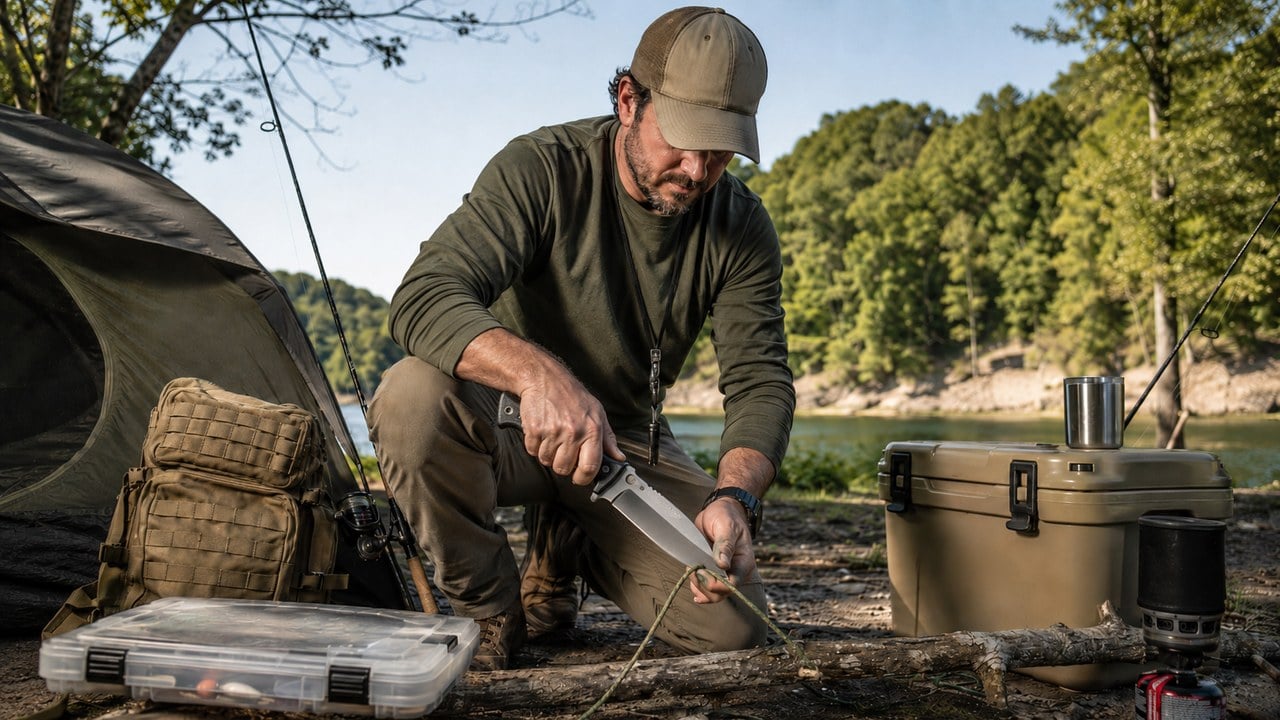
The right outdoor knife comes down to four variables: steel, tang, grind, and handle. Brand and price tag matter less than any of them. A buyer who knows what each variable does can size up any knife on a table and judge it on its own merits, whether it is a hunting blade, a fishing knife, or a camp tool. This is the framework I use, and it has saved me from a lot of expensive mistakes.
What Do You Call Your "Guys Trips"?
Most outdoor knife mistakes trace back to one thing: buying on looks instead of matching the tool to the job. Here is what actually decides how a blade performs in the field.
- Steel type sets the ceiling on edge retention, corrosion resistance, and how easy the blade is to sharpen
- Tang construction decides how much abuse the knife survives before something gives
- Grind geometry changes whether the knife slices food cleanly or chops wood without chipping
- Handle texture and shape matter more in a wet or gloved hand than any material spec
- Maintenance is a five-minute habit that doubles the working life of any blade
Blade Steel and Its Trade-offs
Steel sets the ceiling on edge retention, corrosion resistance, toughness, and how hard the blade is to sharpen. High-carbon steels like 1095 reach 60 to 66 on the Rockwell hardness scale, take a fine edge, and sharpen quickly with basic tools. They also rust the moment they meet moisture without care, which matters in humid country or on the water.
Stainless steels contain at least 10.5% chromium, shrug off corrosion, and require little maintenance, though they rarely hold an edge as long as a hard carbon blade. Powder steels split the difference. CPM 3V is a tool steel built around toughness, so it resists chipping and impact better than high-wear stainless at the cost of some corrosion resistance. That profile suits hard-use camp blades that get batoned through logs. For most buyers, a quality stainless like 14C28N or S30V covers the common outdoor tasks and tolerates the neglect field conditions guarantee.
A fishing trip on the North Carolina coast taught me this the hard way. I took a high-carbon blade I loved for camp work, used it to cut bait and trim line for two days, and by the third morning it was spotted with rust I could not buff out. A stainless folder a buddy loaned me looked the same after a week of saltwater spray. For anything around water - and especially saltwater - stainless saves you the post-trip restoration project.

Planning An Alaskan Cruise Mancation? Here's What You Need to Know
An Alaska Cruise is a fantastic mancation idea, here are some tips to make it an amazing experience.

5 Ways To Have the Ultimate Detroit Guys Weekend
ManTripping: Men's Travel and Lifestyle Blog for busy men who love to travel.

4 Days Treasures of Thailand from Chiang Mai, Small Group
Four-day small group tour from Chiang Mai through the ancient capitals of Sukhothai and Ayutthaya to Bangkok. Ideal for history lovers.

Hollywood Sunsets & Mexican Horizons Cruise
Set sail on a vibrant journey through the stunning coastlines of Mexico, where sun-soaked days and lively nights await. Experience the unique charm of each port while enjoying the luxurious amenities onboard.
Promoted by FlowAds

Fixed Blade and Folding Designs
A fixed blade has no pivot, no lock, and no moving parts to fail. That makes it stronger, faster to deploy, and easier to clean after messy work. It chops, pries, and batons with less risk that the blade folds on your hand. The cost is bulk - a fixed blade rides on a belt or pack and takes more room than a folder.
A folding knife trades some strength for portability. It collapses into a pocket, weighs less, and handles slicing, carving, and general utility well. The lock and pivot are the weak points, because both can loosen or jam with grit and time. For light camp chores and daily carry, a folder is enough. For survival work and heavy cutting, a fixed blade is the safer tool.
Matching the Knife to the Task
Use case narrows the field faster than any spec sheet. A hunter favors a drop-point fixed blade with a fine edge for field dressing, where control matters more than brute strength. A bushcraft knife uses a thick spine and a scandi grind for carving and feathering wood. A tactical knife prioritizes quick deployment and a grippy handle built for hard use, while an everyday carry folder stays small and light enough for a pocket all day. A camp knife is the middle ground, large enough to baton kindling and fine enough to prep food.
Man Gear Pick of the Month
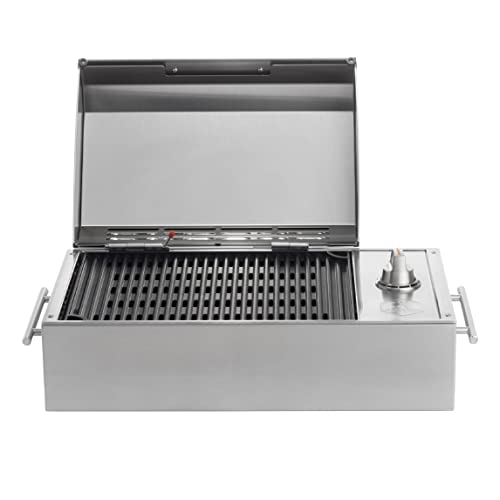
Kenyon City Grill Portable Stainless Steel Electric Grill
Why we picked it: a grill you can actually carry to the campsite, the tailgate or the cabin without borrowing a truck. Stainless, no propane tank to wrestle, and hot enough to cook for four guys rather than reheat for one.
 August's Pick LiberNovo Maxis Electric Big and Tall Ergonomic Office Chair, Graphite 52cm $1,283.00
  July's Pick Powerful Propane Torch Gun, Adjustable Flame Thrower Gun, Kitchen Torch with Detachable Design, Flamethrower Blow Torch for BBQ, Searing Steak, Welding, Camping Charcoal Lighter(Tank Not Included) $42.99
  June's Pick OYASUMI Funny BBQ Man Hot Dog Holders, 4 PCS Reusable Stainless Steel Sausage Stands, Portable Hot Dog Roasters, Barbecue Grill Accessories for Camping & Party Gifts $7.98
 Promoted by FlowAds

I watched this play out on a hunting trip in Texas with a couple of buddies last fall. One guy showed up with an expensive folder built for daily carry and tried to field-dress a hog with it. The blade was sharp enough, but the geometry was wrong - too short, too flat, no real belly to the edge. Another guy had a basic drop-point fixed blade he had owned for ten years, and he was done in half the time with cleaner work. Texas guys trips will sort the gear out fast, and the lesson stuck: name the job first, pick the knife second.
No single knife wins every task. A buyer who starts from a feature list tends to overpay for capability that never gets used.
Tang Construction and Strength
The tang is the part of the blade steel that extends into the handle, and it decides how much abuse the knife survives. A full tang runs the entire length and width of the handle, providing the best balance and maximum strength. Full-tang fixed blades handle batoning, prying, and lateral stress that would snap a lesser design. Partial and rat-tail tangs save weight by narrowing the steel inside the handle - they work for light cutting, but they become the failure point under hard use. For a knife that may need to split wood far from help, full tang is the safer specification.
Blade Grinds and Edge Geometry
The grind is how the steel is thinned down to the edge, and it changes how the knife cuts. A flat grind slices cleanly through rope, food, and light wood, which makes it the most versatile choice for general camping. A convex grind leaves more steel behind the edge, so it holds up better to batoning and chopping. A scandi grind carves wood with control and resharpens easily, though it slices food poorly. Most outdoor users are served well by a flat or convex grind at a moderate angle - wider angles survive hard impact, narrower angles slice better and chip sooner.
Handle, Size, and Carry
A handle has to stay secure in a wet or gloved hand, which is why texture and shape matter more than material alone. Rubber and textured polymer grip well and resist water. Wood and canvas micarta look better and feel better in the hand, though they need more care. Blade length should match the work - 4 to 5 inches covers most camp and trail tasks, while longer blades add chopping power at the cost of fine control. A sheath with solid retention keeps a fixed blade reachable and safe, and a folder needs a clip or pocket that holds it in a known position.
Sharpening and Field Maintenance
An edge degrades with every cut, and field maintenance keeps a blade working between trips. A small whetstone or a pocket sharpener restores a usable edge in minutes. Most outdoor edges are ground between 20 and 25 degrees per side, which balances sharpness against durability. Harder steels rated higher on the Rockwell hardness scale hold that edge longer, though they resist sharpening and chip more readily.
Corrosion is the other half of maintenance. Carbon blades left wet rust within hours, and that surface rust pits the steel and ruins an edge. A wipe-down and a light coat of oil after each trip stops it. Stainless steel tolerates far more neglect, yet even it corrodes in salt air without basic cleaning.
Why Some Knives Cost Twenty Times More
There is a real split between utility knives that come off a manufacturing line and outdoor knives that carry the design and artistic choices of a master craftsman. Both can be excellent. A factory-made stainless folder from Lowes or Amazon will cut as well as a hand-forged blade that costs ten or twenty times more, because the underlying steel and geometry are doing the same job. What the premium price buys is heritage, fit and finish, and the feel of something built by a person who cares about the work, the same way a fine bottle of wine reflects a winemaker's signature instead of a factory's spec sheet.
I keep several knives in my own kit that are not expensive and not low quality. They are technically very similar to blades that cost ten or twenty times more, and they cut just as well. The custom pieces I own do not perform better in the field, they feel different in the hand. Is that feeling real? Absolutely. Does it make the knife sharper or tougher? No. It makes it more expensive.
So whether the buy is a hunting knife for deer camp or a fine chef's knife for trimming a brisket and chopping vegetables, the first question is what you actually want from the purchase: a working tool, a piece of craftsmanship you will use and admire, or both. Name the goal up front and you stop paying premium prices for performance a thirty-dollar blade already delivers, and you stop buying a factory blade when what you really wanted was a knife you would be proud to hand down.
Take The Time To Shop Before Buying A Knife You'll Actually Use
The best outdoor knife is the one you can use, sharpen, and trust without thinking about it. For most guys, that points to a medium fixed blade in a quality stainless steel, with a full tang and a flat or convex grind. Specialists can refine from there, choosing carbon steel for edge work or a folder for daily carry. A knife chosen around the real job, maintained with a quick clean and a light oil after each trip, will outlast the next three you buy chasing a better version - and it is ready in the drawer when you start packing for your next trip.

Promoted by FlowAds
