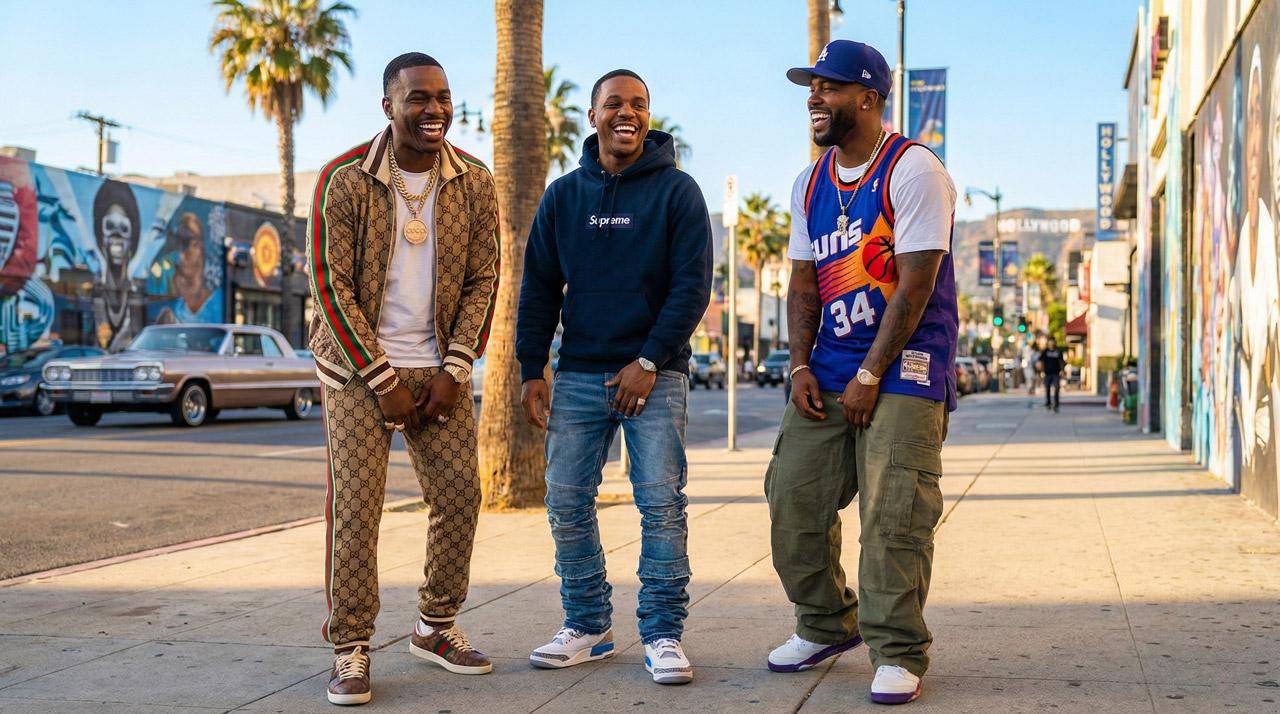
Hip hop didn't just change music - it rewrote the rules of men's style. What started on the streets of New York in the early 1980s has become the dominant influence on how men dress today, from sneaker culture to luxury streetwear to the oversized silhouettes that show up on runways and in your closet.
What Do You Call Your "Guys Trips"?
- Run-DMC's 1986 Adidas deal was the first endorsement between a musical act and an athletic company, creating the blueprint for every sneaker collaboration since.
- Dapper Dan pioneered "logomania" from his Harlem boutique starting in 1982, turning luxury brand symbols into streetwear decades before high fashion caught on.
- Black-owned brands like FUBU generated $350 million by 1998 and Cross Colours hit $100 million, proving streetwear's commercial viability.
- The oversized silhouette that dominates contemporary fashion originated from hip hop's rejection of restrictive, tailored clothing in the late 1980s and 1990s.
- Today's luxury streetwear market - from Off-White to designer sneaker collaborations - traces directly back to hip hop culture's fusion of street style and high-end aspiration.
The connection between hip hop and fashion runs deeper than celebrity endorsements. Artists didn't just wear clothes - they created entire aesthetic movements that redefined what men could wear and how they could wear it. Here are the key trends that crossed over from hip hop culture into mainstream men's style.
Sneaker Culture
Before Run-DMC, sneakers were athletic equipment. After them, sneakers became cultural currency.
The shift happened in 1986 when the group released "My Adidas" and performed it at Madison Square Garden. When they asked the audience to hold up their Adidas sneakers, tens of thousands of fans responded. An Adidas executive in attendance witnessed the moment and the brand offered the group a $1 million endorsement deal - the first of its kind between musicians and an athletic company.
Run-DMC wore their Adidas Superstars unlaced with the tongues pushed out, a style borrowed from New York street culture. That specific look became instantly recognizable worldwide. More importantly, the deal established that what artists wore could drive consumer behavior at massive scale.
Every sneaker collaboration you see today - whether it's a limited Jordan drop or a designer partnering with Nike - follows the template Run-DMC and Adidas created nearly four decades ago. The sneaker resale market, the hype around releases, the idea that footwear communicates identity - all of it traces back to hip hop.
Tracksuits and Athletic Wear as Everyday Clothing
The same Run-DMC aesthetic that elevated sneakers also normalized wearing full athletic gear outside the gym. Their signature look included matching Adidas tracksuits worn head to toe, an approach that seemed radical at the time but is now standard practice.
This wasn't accidental. Early hip hop fashion rejected the flashy, costume-like looks of disco-era performers. Run-DMC and their peers chose to dress like their audience - like the b-boys, break dancers, and kids from their neighborhoods in Queens. The tracksuit represented that authenticity.
I've watched guys show up to casual business dinners in matching track sets that would have gotten them turned away twenty years ago. Today, wearing a track jacket and pants to hang with the guys or to a casual networking event barely registers as unusual. Athletic brands now design their apparel specifically for off-court wear. That shift happened because hip hop made sportswear acceptable - and eventually aspirational - as regular clothing.
Luxury Logomania
Before high fashion embraced logo-heavy designs, a Harlem tailor named Daniel Day - known as Dapper Dan - was creating them for hip hop's biggest names.
Dapper Dan opened his boutique on 125th Street in 1982, operating 24 hours a day to accommodate clients including LL Cool J, Eric B. & Rakim, Salt-N-Pepa, and boxer Mike Tyson. His trademark was transforming luxury brand symbols - Gucci, Louis Vuitton, Fendi - into custom streetwear pieces. He took logo patterns meant for handbags and turned them into jackets, tracksuits, and car interiors.
The luxury houses sued him and his shop closed in 1992. But decades later, those same brands began producing designs that looked remarkably similar to what Dapper Dan had created. In 2017, Gucci officially partnered with him after social media called out their use of his aesthetic without credit. He now operates an atelier in Harlem backed by Gucci.
The logomania trend that dominates luxury fashion today - the prominent branding, the status symbols worn as statements - originated in hip hop culture's desire to project success and aspiration through clothing. Dapper Dan understood that impulse and built an entire design philosophy around it.
Oversized and Baggy Silhouettes
The tight, tailored looks of earlier decades gave way to dramatically oversized clothing as hip hop entered the 1990s. Artists like Tupac Shakur, The Notorious B.I.G., and members of Wu-Tang Clan popularized baggy jeans, oversized jackets, and loose-fitting everything.
This wasn't purely aesthetic. Karl Kani, the Brooklyn-born designer who became one of streetwear's pioneers, explained the practical origin: the style allowed freedom of movement that tight clothing couldn't provide. Many artists also came from neighborhoods where sharing clothes between siblings and friends was common, making looser fits a practical reality that became a style choice.
Brands like FUBU, Cross Colours, and Karl Kani built empires on this silhouette. By the late 1990s, FUBU had generated $350 million in sales. The oversized look became synonymous with hip hop identity - and eventually crossed over into mainstream fashion entirely.
Today's relaxed fits, wide-leg pants, and oversized outerwear all carry DNA from this era. The pendulum has swung back and forth on exactly how baggy is acceptable, but the fundamental shift away from restrictive tailoring as the only option for men started here.
Stacked Jeans and Contemporary Denim
The evolution of hip hop denim didn't stop with baggy fits. Contemporary streetwear has developed the stacked jean - a slim or tapered cut with extra length that creates deliberate bunching at the ankle.
This style bridges hip hop's denim heritage with modern silhouettes. Rather than the extremely wide legs of 1990s baggy jeans, stacked denim jeans offer a fitted look through the thigh with dramatic stacking where the fabric meets the shoe. The effect draws attention to footwear - maintaining that sneaker-centric focus hip hop established - while updating the overall proportion.
The stacked look works particularly well with high-top sneakers or boots, creating a visual line that feels intentional rather than accidental. It's become a staple in contemporary streetwear and represents how hip hop fashion continues to evolve rather than simply recycling old trends.
Gold Chains and Statement Jewelry
Heavy gold chains - particularly the thick rope chains known as "dookie ropes" - became defining accessories in hip hop's early years. Run-DMC wore them prominently, as did virtually every major artist of the era.
The jewelry served multiple purposes. It was a visible display of success, a connection to African and Caribbean jewelry traditions, and a rejection of the idea that men's accessories should be subtle or understated. Hip hop embraced bold, obvious statements - and jewelry was part of that language.
While the specific styles have evolved, the underlying principle remains. Men wearing visible chains, statement watches, and bold rings can trace that cultural permission directly to hip hop. The genre made it acceptable - expected, even - for men to wear jewelry as a deliberate style choice rather than hiding it.
From the Streets to Everywhere
What makes hip hop's fashion influence remarkable is its staying power and reach. Styles that started in specific New York neighborhoods now show up in men's travel wardrobes, weekend wear, and even professional settings where dress codes have relaxed.
The relationship has also reversed. Luxury brands that once distanced themselves from hip hop now actively court collaborations. Louis Vuitton appointed Pharrell Williams as creative director. Gucci partners with Dapper Dan. High fashion and streetwear have merged to the point where the distinction barely exists.
Building a Style That Acknowledges the History
Understanding where these trends originated helps you wear them with intention. Sneaker culture, logomania, oversized fits, statement jewelry, and the tracksuit-as-outfit all came from somewhere specific - and knowing that context makes the choices feel less random and more deliberate.
Hip hop fashion was always about self-expression, status, and identity. Those motivations haven't changed. Whether you're putting together a look for a weekend with the guys or building a wardrobe that reflects who you are, the influence is already there in your closet. The only question is whether you're aware of it.