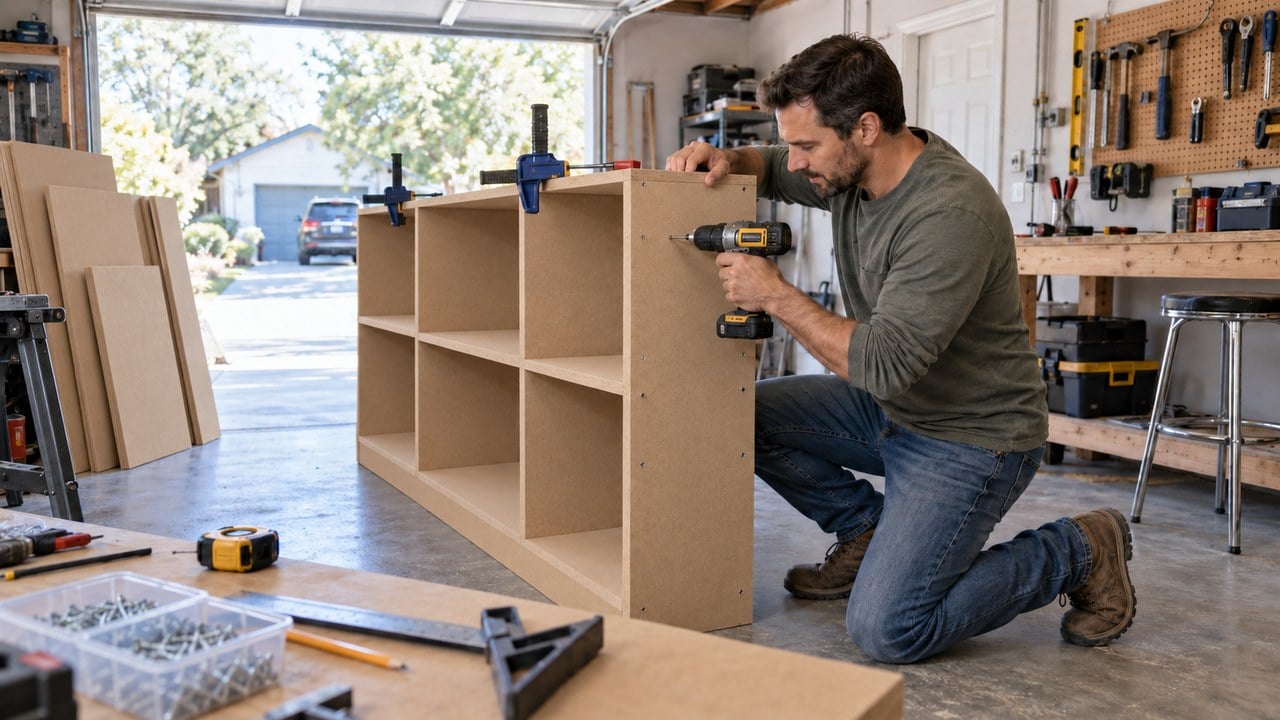
Medium-density fiberboard sits one rack over from the plywood, costs less, and comes off the pile dead flat every time, which makes it the right material for a whole category of indoor builds. These five weekend projects use MDF where it performs best: garage storage, a media unit, office shelving, an entryway bench, and wall paneling. The last section covers the jobs where plywood or solid wood is the better buy.
What Do You Call Your "Guys Trips"?
Every project below starts the same way: breaking down a full sheet without wrecking the edges or filling the garage with dust.
- A circular saw and a clamped straightedge cut MDF as cleanly as a table saw, so a full shop is not the barrier most guys assume it is.
- Use a fine-tooth blade, 60 tooth or higher, because coarse framing blades tear the face and leave a torn edge you will spend the evening filling.
- A 3/4-inch 4x8 sheet weighs roughly 96 pounds, about 60 percent more than the same sheet of plywood, so plan on a second set of hands for the first cut.
- Support the whole sheet on foam or sawhorses before cutting, since MDF sags under its own weight and a sagging sheet pinches the blade.
- Wear a P100 or FFP3 respirator instead of a paper dust mask, and cut outside or with extraction running, because MDF gives off formaldehyde along with the fine dust.
None of these builds need a dedicated shop. A drill, a circular saw, a straightedge, and a tape measure get you through all five, which is why they suit a man cave on a budget as well as a finished workshop.
Build Better Garage Storage
The garage is where storage goes to die. Tools, sports gear, car-care bottles, and boxes nobody has opened since the move all end up on the same shelf, and that shelf was never designed for any of it.
Start by separating what you reach for weekly from what comes out twice a year. That split decides the layout: daily items at chest height in open storage, seasonal gear high and behind doors. Then build around the wall you have. Standard cabinet dimensions almost never fit the space.

Exploring Puerto Vallarta's Street Food Scene on a Taco Tour
Exploring the Puerto Vallarta street food scene on a Taco Tour with Vallarta Food Tours is a safe, fun and tourist friendly way to experience the real tastes and smells of Mexican street food.

Glaciers, Salmon, Bears and More on an Alaska Cruise
An Alaska cruise is a bucket-list experience for many people. Here's what to expect.

Kadún Hotel Boutique
Experience design suites, artisan dining, and premium lifestyle amenities in the heart of Cabo San Lucas. Walk to Medano Beach and the Marina boardwalk.

Things We Loved About Virgin Voyages That You Won't Find On Other Cruises
A look at what makes Virgin Voyages different, from inventive dining to a fun, inclusive vibe, for travelers seeking a fresh cruise experience.
Promoted by FlowAds

For cabinet sides, doors, and shelf faces, mdf sheets give you a smooth, consistent surface that paints out clean and costs less than cabinet-grade plywood.
One garage-specific step comes first: seal every cut edge before the shelves go up. Bare MDF edges pull moisture out of humid air, and a garage swings a long way between February and August. Prime and paint all six faces, or buy moisture-resistant MDF, the green-core version, if your garage runs damp.
Finish with labeled bins sorted by category. If the overflow has already outgrown the walls, a shed conversion is the other half of that problem.
Man Gear Pick of the Month
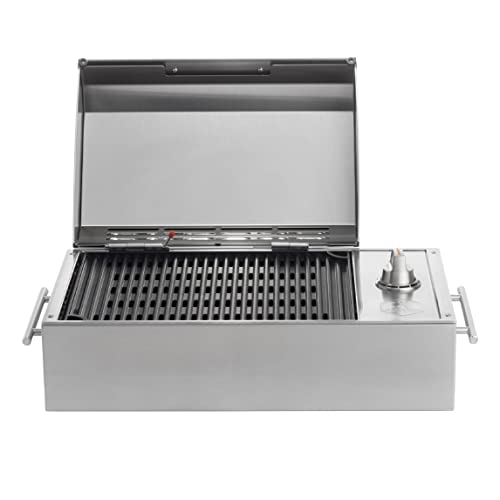
Kenyon City Grill Portable Stainless Steel Electric Grill
Why we picked it: a grill you can actually carry to the campsite, the tailgate or the cabin without borrowing a truck. Stainless, no propane tank to wrestle, and hot enough to cook for four guys rather than reheat for one.
 August's Pick LiberNovo Maxis Electric Big and Tall Ergonomic Office Chair, Graphite 52cm $1,393.00
  July's Pick Powerful Propane Torch Gun, Adjustable Flame Thrower Gun, Kitchen Torch with Detachable Design, Flamethrower Blow Torch for BBQ, Searing Steak, Welding, Camping Charcoal Lighter(Tank Not Included) $42.99
  June's Pick OYASUMI Funny BBQ Man Hot Dog Holders, 4 PCS Reusable Stainless Steel Sausage Stands, Portable Hot Dog Roasters, Barbecue Grill Accessories for Camping & Party Gifts $7.98
 Promoted by FlowAds

Create a Built-In Media Unit
Televisions got thinner while everything around them multiplied. Two consoles, a soundbar, a streaming box, four controllers, and a nest of charging cables turn a clean room into a wall of black plastic.
Measure the TV and every device before cutting anything. Leave 2 to 3 inches of clearance behind the components for cables and airflow, because a console in a sealed cubby runs hot and loud.
Open shelving works if you swap gear often. Doors make sense for controllers, spare cables, and everything that does not need to be on display. Paint the finished unit the same color as the wall and it looks built-in.
The same equipment wall is what a man cave needs before the bracket drops. On guys night in the game goes on and nobody is behind the couch untangling an HDMI cable.
Add Home Office Shelving and a Monitor Riser
A home office has to work first. If your desk is ringed by paper stacks and a power strip you cannot reach, the fix is almost always vertical.
One shelf above the desk clears more surface than a second filing cabinet ever will. Keep it shallow, 8 to 10 inches, so it holds books and gear without eating headroom or casting a shadow on the desk.
A monitor riser is the small version of the same idea, and it is a one-evening build: a top and two ends, glued and screwed. Raising the screen frees the space underneath for a keyboard and puts the display at a height that does not wreck your neck by 4 p.m.
Make a Custom Entryway Bench
Shoes, bags, jackets, keys. All of it collects within six feet of the front door whether there is anywhere to put it or not.
A rectangular frame with a seat on top and open storage below handles most of that. Add vertical dividers for individual cubbies, or skip the dividers and drop in baskets. If the front door is where everyone piles their gear on a weekend with the guys, size it for four people.
Store-bought entryway furniture comes in a handful of standard widths and none of them match the wall you have. Build to the gap and use the full depth.
A coat rail or narrow shelf above the bench finishes the setup without taking another inch of floor.
Add Simple Wall Paneling
This is the job MDF was made for. Paint-grade trim and paneling is where it beats solid wood outright: no grain telegraphing through the paint, no cupping, no knots bleeding through primer, and a lower cost per linear foot than most hardwood profiles.
Rectangular molding patterns give you a traditional look, and evenly spaced vertical strips go contemporary. Either way the layout takes longer than the cutting.
Sketch it on paper with real measurements before anything touches the wall. Check spacing against outlets, switches, door casings, and where the furniture sits, so the finished wall looks deliberate.
Fill the seams, caulk the edges, and paint the whole wall one color. Skip that step and the panels look like separate strips stuck to drywall.
Know Your Woods - MDF Is Great, But It Isn't Right For Every Home Improvement Job
Four sheet materials show up across these projects, and they are not interchangeable.
- Plywood - stronger, lighter, and it holds screws well in every direction including the edge. It costs more, often two to three times what particleboard runs, and the face grain shows through paint. Use it for anything structural, anything spanning distance, and any shelf that will carry tools, paint cans, or a stack of lumber.
- MDF - wins on surface. Dead flat, no grain, and it machines cleanly for profiles and curves, which is why molding and cabinet doors get made from it. It holds screws fine through the face and poorly into the edge, so pilot holes are not optional there. It is also the heaviest sheet good here, and the most sensitive to humidity unless you seal it or buy the green-core version.
- Particleboard - cheaper than MDF and worse at nearly everything else, especially holding a screw. It has a place in low-load interior boxes and not much past that.
- Solid wood - for anything that takes abuse or gets stained instead of painted: stair parts, mudroom trim, bathroom casing. Where water actually lands, rather than where humidity just swings, this is the one to buy.
For most of these builds the answer is a mix. Plywood carcass, MDF doors and face frames, and you get plywood's strength behind MDF's finish. That is how production cabinet shops do it, and there is no reason a garage build should not.
Whichever you pick, MDF changes how you drive fasteners. Pilot-drill anything going into an edge or the material mushrooms and splits, and a clutch you can dial down matters more than raw torque. If your drill predates cordless lithium, the cordless drills worth owning have gotten a lot better at exactly this.
The common mistake is starting at the material and hunting for something to build with it. Start at the problem instead: the shelf that keeps sagging, the tangle behind the TV, the pile by the front door.
If this is your first sheet, build the entryway bench. It is the smallest of the five, it teaches you edge sealing and pilot holes on something that takes abuse without needing to look perfect, and one weekend tells you whether you want to spend the next one on cabinet doors.
One thing worth knowing before you buy: most home centers will break a full sheet down on their panel saw, with the first several cuts free and roughly a quarter to fifty cents each after that. Policies vary by store, and the cuts land within about an eighth of an inch of your mark, so treat it as transport help rather than final dimensioning. Getting four manageable pieces to the truck solves the loading problem and the first-cut problem in the same trip.

Promoted by FlowAds
