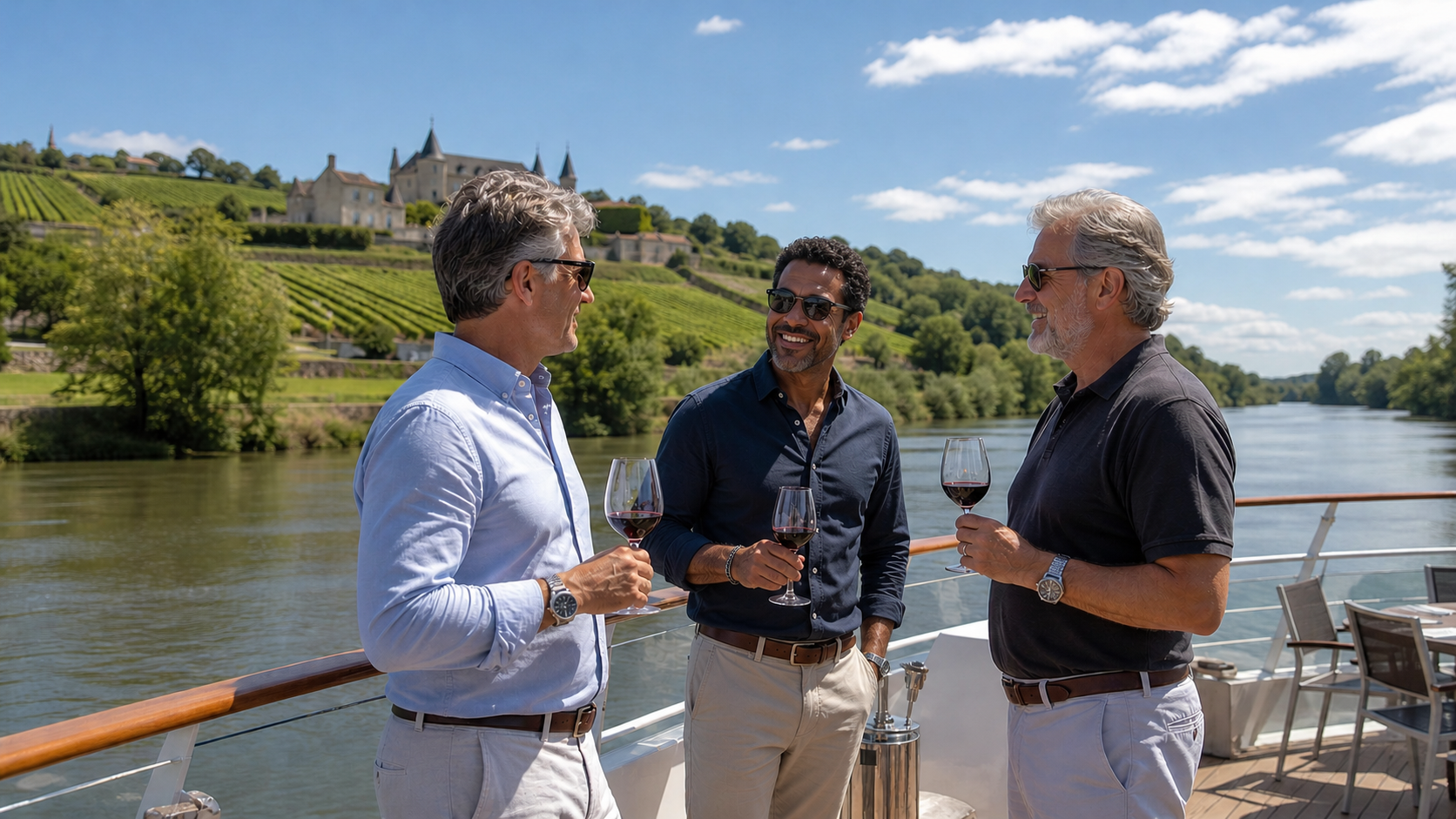
European river cruises tend to get pitched as the soft option. Couples celebrating an anniversary, retirees on a slow tour of vineyards, families splitting cabins. That framing misses the actual draw. A week sailing the Rhine, the Garonne, the Douro, or the Rhône hands a group of guys a moving home base, dinner reservations someone else booked, and a different city or wine region every morning without anyone playing trip leader. No driving on the wrong side of the road. No hauling bags between five hotels. Strong drink list, late nights on deck, and a captain who handles the navigation.
The four river cruise routes below are my top picks for men who think that a river cruise is just something for a romantic vacation with their partners - it's that too of course, but European river cruises are amazing for men too! Each of these rivers offers it's own unique culture and history to explore: castles and breweries, grand cru classified vineyards, port wine cellars carved into the riverbank, or 2,000-year-old Roman engineering.
What Do You Call Your "Guys Trips"?
- The ships are small enough (130 to 190 passengers on most lines) that the bar staff knows your group's order by night two, and there's no waiting for elevators or fighting for deck chairs.
- Port stops are right downtown. You walk off the ship into the old town, not a 45-minute bus ride from a cruise terminal in an industrial port.
- All-inclusive pricing on lines like AmaWaterways, Avalon, and Viking covers wine and beer with lunch and dinner, which kills the running tab math that wrecks group budgets.
- Daily excursions split into active and relaxed tracks. Bike the towpaths, hike up to the castle, or stay aboard with a book and a cold one. Nobody has to fake enthusiasm for a tour they don't want.
- Itineraries are typically 7 or 8 nights, which lines up with a week of PTO and leaves a buffer day on either end for jet lag and getting home.
One practical note before getting into the destinations, and it applies to most Europe trips, not just for river cruises: most of these itineraries cross borders or duck into countries where your US carrier's roaming plan turns into a budget event of its own. A travel eSIM for Europe and UK loaded before you leave is the simplest fix. The whole group lands with working data, group chats stay alive when the ship's Wi-Fi cuts out between locks, and nobody is the guy reactivating his phone in the middle of dinner. Worth handling at the gate before you board the flight over, not at 2 AM in a hotel lobby in Amsterdam.
Four European Rivers Perfect For A Guys Getaway
There's a version of a European river cruise for almost any group personality: beer guys, wine guys, history guys, food guys. These four cover the spread, and each one anchors a different region with enough depth to fill a week without burning anyone out.
How To Plan The Perfect Ranch Bachelor Party Guys Trip
ManTripping: Men's Travel and Lifestyle Blog for busy men who love to travel.
I Tried Cellular At Sea Cruise+ On Norwegian Getaway
A hands-on review of the Cellular At Sea Cruise+ service on Norwegian Getaway, useful for cruisers deciding whether to stay connected at sea.

12-Day Vietnam Discovery Tour
A 12-day Vietnam tour from Hanoi to Ho Chi Minh City covering Halong Bay, Hoi An, Cu Chi Tunnels and the Mekong Delta. Ideal for first-time visitors.

Travel to Vietnam Cambodia and Thailand in 12 days
A 12-day Vietnam, Cambodia and Thailand tour through Hanoi, Halong Bay, Angkor, Bangkok, Ayutthaya and Chiang Mai, ideal for culture lovers.
Sponsored

The Rhine: Castles, Kölsch, and Roman Ruins
A Rhine river cruise is the entry point most groups should start with. The classic route runs Amsterdam to Basel, Switzerland (or the reverse) over 7 or 8 nights, hitting Cologne, Germany, then Koblenz, the Middle Rhine Gorge, Rüdesheim, Speyer, and Strasbourg, France. It's the sampler platter of Western European travel, and it's built for a group that wants variety over depth.
Cologne, Germany is where the trip really shines for a Germany guys trip. The twin spires of the Cathedral are the photo, but the actual move is the brewery hall circuit in the Altstadt: Früh am Dom, Päffgen, and Malzmühle. A traditional Cologne brewery tour means small 0.2-liter glasses of Kölsch served nonstop by waiters in blue aprons called Köbes, who keep refilling until you put a coaster on top of the glass. It's the closest thing Germany has to a beer-hall pub crawl, and it's all walkable from where the ships dock.
Past Cologne, the Middle Rhine Gorge between Koblenz and Bingen is the UNESCO stretch with roughly 40 castles in 40 miles. Most cruises sail this section in daylight specifically so the bar deck fills up while passengers point out Marksburg, Burg Katz, Burg Maus, and the Lorelei rock. For history guys, the side excursion to Trier, Germany (the country's oldest city) gets you Porta Nigra, Roman baths, and the 20,000-seat amphitheater where the gladiator games, animal hunts, and public executions actually happened, built into the city wall in the 2nd century. Trier is closer to most Rhine itineraries than people realize, especially on lines that detour up the Moselle.
Wine on the Rhine is Riesling country, particularly around Rüdesheim in the Rheingau. It's drier and more food-friendly than most Americans expect from German Riesling, and the tastings on the Drosselgasse are casual in a way that suits a group. Viking, AmaWaterways, Avalon, Uniworld, and Scenic all run this route. Pricing in 2026 generally runs $3,000 to $6,000 per person depending on cabin category and season.
Bordeaux: Garonne, Dordogne, and the Grand Cru Run
A Bordeaux river cruise is the trip for the group that takes wine seriously, or wants to. The route is unique. Instead of a long linear path, ships sail a roundtrip loop out of Bordeaux, France through the Gironde estuary, up the Garonne to Cadillac, and up the Dordogne to Libourne and Saint-Émilion. Seven nights, no repositioning flights, and the ship is parked in central Bordeaux for the bookend nights so you get the city plus the regions. It's basically the framework of a wine-focused mancation without anyone having to plan it.
Saint-Émilion is the headline. The medieval village is built on top of an underground monolithic church carved out of the limestone in the 12th century, and the surrounding vineyards include the classified estates that produce some of the most expensive wine in France. Most cruise excursions get you into one or two grand cru classé châteaux for tastings, with names like Château de Ferrand and Château La Dominique that show up on serious wine lists. This is the level of access a couple of guys couldn't easily book on their own.
The Médoc side of the trip (Pauillac, Margaux, Saint-Julien) is the cabernet-dominated left bank, home to Château Mouton Rothschild, Lafite, and Latour, with second-growth Saint-Julien estates like Léoville Barton more accessible for tastings than the first growths. A proper Médoc wine tour through the cruise excursion program gets you visits the public booking sites can't. For a group that wants the trip without the wine fixation, Blaye's UNESCO citadel and the Bordeaux food scene (canelés, oysters from the Arcachon basin, duck everything) fill the days on their own.
This route is shorter and more concentrated than the Rhine: fewer port stops, more time per stop, more wine per port. CroisiEurope, Scenic, Uniworld, AmaWaterways, and Viking all run Bordeaux itineraries, with most groups sailing April through October. Spring and harvest (September and October) are the peak windows.
The Douro: Port Wine, Quintas, and the Quietest Cruise in Europe
A Douro river cruise is the underrated pick. Portugal's Alto Douro is the world's oldest demarcated wine region, UNESCO listed and terraced into granite hillsides above the river, and it produces nearly all the world's port plus a serious lineup of still reds. The route runs roundtrip from Porto, Portugal, sailing inland to Pinhão and the Spanish border over 7 nights.
Porto itself is the kind of city that punches above its weight for a guys trip. The wine lodges are across the river in Vila Nova de Gaia, Portugal (Taylor's, Graham's, Sandeman, Croft, Kopke), and a Vila Nova de Gaia port lodge tour takes a full afternoon to do right. You're walking through cellars stacked with barrels older than most American buildings, tasting tawnies and vintages that simply aren't sold at this level outside Portugal. Dinner back across the bridge in Ribeira, then port and a cigar at one of the rooftop bars looking back at the lodges lit up at night.
Once the ship sails inland, the pace drops to almost nothing, and that's the point. The Douro is narrower, slower, and quieter than the Rhine or the Rhône, and a quinta visit in the Pinhão region is more like a working farm than a tourist operation. You're walking the terraces with the winemaker. The river is also the only navigable wine route in the world that's also a working hydroelectric system, so the locks themselves are part of the experience.
This is the route for a group that wants the wine country trip without the structured pace of Bordeaux. Tauck, Viking, Uniworld, AmaWaterways, and Scenic all run Douro itineraries. The ships are smaller (typically 100 to 130 passengers) because of the locks, and the season is tighter: April through October, with summer running hot in the inland valley.
The Rhône: Roman Engineering, Provence, and the Côtes du Rhône
A Rhône river cruise is the trip for the history group. The standard route runs Lyon, France to Avignon (or Arles), 7 nights, with side trips to Vienne, Tournon, Viviers, and the Pont du Gard. It's denser with Roman archaeology than any other European river route, and it pairs that with Lyon's food scene and Provence on the other end.
Lyon is the food capital of France: bouchons (the small, casual restaurants serving Lyonnaise classics), the indoor market named after Paul Bocuse, and a beer and bistro scene that holds up against any city in Europe. Most cruises overnight in Lyon, which means the group gets one proper dinner out and a night to drift through Old Lyon's bouchon district at human pace.
Then the route pivots into Roman territory. Vienne has a Roman temple and theater. Avignon's Palace of the Popes is the largest Gothic palace in the world, built when the papacy moved out of Rome in the 1300s, and the bridge in the song is right there. The side trip to the Pont du Gard is the one that lands hardest: a 2,000-year-old Roman aqueduct, 160 feet high and over 900 feet long, dry-fitted from limestone blocks weighing six tons each. It's still standing because the engineering was that good. For anyone who's ever been impressed by a bridge, this is the bridge.
Wine on the Rhône is Côtes du Rhône and Châteauneuf-du-Pape: heavier, warmer, more grenache-driven reds than Bordeaux, and most cruises get you into a Châteauneuf-du-Pape estate tasting. For a guys trip to France that wants more substance than just wine country, the route packs more Western civilization than any other European river option, paired with the best food on any of the four. Viking, Avalon, AmaWaterways, Uniworld, and Scenic all run the Lyon-to-Provence route. Pricing matches the Rhine, with shoulder seasons (April through May, September through October) being the cleanest weather window.
Consider A Barge Cruise For A Group Of Guys Traveling Together
If a group wants the canal-and-vineyard experience but the river-cruise model feels too structured (too many strangers, too much programming, fixed daily schedule), a hotel barge is a different category of trip and worth understanding before booking. This is where the group of 8 to 12 guys who already know each other should be looking, especially for a milestone trip.
A European barge rental on a hotel barge typically carries 6 to 20 passengers, runs along the smaller canals at 3 to 6 miles per hour, and covers maybe 10 to 20 miles a day. The Burgundy canals, the Canal du Midi in southern France, the Champagne region, and waterways in the Netherlands, England, and Scotland are the main playgrounds. Operators like European Waterways, Belmond, and French Country Waterways run hotel barges with full crews (captain, chef, hostess, tour guide), and the entire boat can be chartered privately for a single group.
The math changes how you should think about it. A barge cruise costs more per person than a comparable river cruise, but it includes everything: all meals, all wines, all excursions, an open bar, and a private van that follows the barge with an English-speaking guide who hauls the group to vineyards, châteaux, and lunch spots the river ships can't reach. For a group of 10 chartering the whole boat, the per-person cost lands closer to a high-end all-inclusive than a luxury cruise, and the trip is genuinely customizable, including which wineries you visit and what you eat for dinner.
The Burgundy run is the classic, passing through Beaune, the Côte d'Or, and Chablis, with private tastings at producers most American wine buyers know by name only. The Canal du Midi runs through the Languedoc, more relaxed and warmer, with side trips to Carcassonne and Cathar castles. Either one is the kind of trip a group remembers a decade later. The trade-off is pace. If the group wants to cover four countries and ten cities in a week, a barge cruise is the wrong call. If the group wants to slow down, eat well, and actually drink the wine instead of taking pictures of it, it's the better call.
How to Choose the Right European River Cruise for Your Guys Trip
Before you lock anything in, a handful of decisions will shape how the entire trip plays out - from cabin selection to timing to how you spend your days on shore.
- Book early if you want French balcony cabins - the best inventory is gone 9–12 months out for peak dates.
- Groups of four or more can unlock real value with onboard credits, comped excursions, or block-booking perks.
- Aim for spring (April–early June) or early fall (September–October) for the best overall conditions - with the Douro stretching warm later into fall.
- Pack a sport coat if you’re sailing with higher-end lines like Uniworld, Scenic, Tauck, or Riverside - otherwise, most ships lean casual.
- Prioritize a few premium excursions like Saint-Émilion tastings or Douro quinta lunches and let the included tours fill in the rest.
Ultimately, the right river comes down to the kind of trip your group actually wants. The Rhine delivers variety and energy, Bordeaux rewards serious wine focus, the Douro slows things down for tighter crews, and the Rhône leans into history and culture. If this is a milestone trip, though, a private barge changes the equation entirely - trading pace for flexibility and turning a good guys trip into one you’ll still be talking about a decade from now.

What to Know Before Working with a Nightlife Concierge for Your Vegas Trip
Las Vegas nightlife concierges transform chaotic club nights into seamless experiences. Skip lines, secure dedicated space for your crew, and navigate Vegas nightlife like an insider with expert coordination.
Why You Should Consider Michigan For Your Next Guys Weekend Getaway
Michigan guys weekend getaway
Beyond Detroit: Best Places In Michigan For A Guys Trip
Discover Michigan's best guys trip destinations, from Grand Rapids' brewery scene to outdoor adventures in Pictured Rocks and Copper Harbor.
Sponsored
