I was the first student at my high school to get real internet access, through a partnership with UMASS, and before that I was dialing into strangers' computers to play board games on BBSs and chatting on PRODIGY. That head start is why I read the current wave of lawsuits against Roblox and the social platforms differently than most guys my age. The danger those cases describe is not imaginary, but the reflex most parents reach for - lock it down, scare him straight - is the one that backfires.
What Do You Call Your "Guys Trips"?
Most of the protective work happens in two places: a settings menu that takes about ten minutes, and a conversation that takes about five.
- The account setting that locks down chat, and where Roblox keeps it
- Why grooming almost never looks like a stranger asking a scary question
- What Roblox changed in June 2026, and the gap those changes still leave open
- The spending cap that goes unset until the card statement shows up
- Who to call if it has already happened
I have reviewed games on this site and interviewed a Call of Duty voice actor about the craft. Games are not the problem here. What changed since my first BBS is the scale, the money, and the size of the room.
What the Roblox and Social Media Lawsuits Allege
In December 2025, federal courts consolidated dozens of child exploitation cases against Roblox Corporation into a multidistrict litigation in the Northern District of California, MDL 3166. The core allegation is not that the games harmed anyone, but that the company grew faster than its safeguards, with age verification and parental controls lagging behind. Every claim in an active Roblox lawsuit remains an allegation until a court says otherwise, and Roblox has contested the central claims.
Separately, Roblox settled with Nevada, Alabama and West Virginia in April 2026 for $35.8 million combined, agreeing to ID and facial age verification, chat restrictions for users under sixteen, and a ban on encrypted messaging involving minors. Settlements are not admissions of liability. Similar claims are being litigated well beyond gaming: MDL 3047 has consolidated thousands of federal actions against Meta, TikTok, Snap and YouTube over adolescent safety and addictive design. Those same questions apply to any platform your kid uses.
How a Stranger Gets to Your Kid in the First Place
Roblox gives players text chat, voice chat, friend requests, private servers and trade windows. They exist because he is there to play with other people, and stripping them out leaves an expensive single-player game. They are also five separate doors, watched by a review queue slower than a conversation.
A username tells your kid nothing. A polished avatar, a rare item, a high-level badge, a shared game - children read all of it as evidence of a peer. An adult with bad intent knows how cheap those signals are to fake. I learned that early, dialing into boards with no idea who was on the other end.
Grooming Looks Like Friendship, Not Danger
The mental image most parents carry is a stranger saying something alarming and a kid recognizing it. It rarely arrives that way. It starts with attention: praise for a build, help with a hard level, a gift of in-game currency, a spot in a group. Thorn's research on how online grooming works describes a slow escalation into shared secrets, private jokes, then a suggestion to move somewhere with fewer eyes on it.
The child experiences that as being chosen, not targeted. There is no single sentence to catch, no keyword a filter can flag, and nothing your kid would report because nothing has felt wrong yet. What you can watch for is on your side of the screen: secrecy about who he is talking to, items or Robux he cannot account for, a friend he will not name, a mood that drops when he logs off.
Robux, Skins, and Trades With Strangers
Robux is virtual currency, and virtual currency blurs the link between a purchase and its cost. It works on adults too. Add limited drops, countdown timers, and items that mark who spent and who did not, and you have a kid making status purchases under social pressure. Watch trading most closely, where kids hand over items to someone who promised something back and vanished.
There is a data layer under it. Purchases, play patterns, friend graphs and device details get collected, and some of that does help spot abuse. The money is the part you can control. Set a cap under Settings, then Parental Controls, then Monthly Spending Limit. It needs a parent PIN and does not cover Robux bought with gift cards.
The Design Choices That Keep Him Logged On
Streaks, daily login bonuses, timed events, limited-run items. Retention mechanics like these are standard product design across the industry. In MDL 3047, plaintiffs' attorneys have argued that specific engineering choices - infinite scroll, autoplay, variable-interval notifications, algorithmic feeds - work as deliberate tools that override a user's intentions. Whether courts accept that argument is unsettled.
For a twelve-year-old the pull is social as much as mechanical. Logging off means the group keeps playing without him and he loses a streak he has held for six weeks. That cost is real to him, and telling him otherwise is how you lose the argument. Name the mechanic out loud instead - this is what makes quitting feel expensive.
Where Moderation and Reporting Fall Short
Automated filters catch banned words. They do not catch coded language, deliberate misspellings, or a conversation that stays clean for three weeks before it turns. Voice chat is harder still, because there is no text for a filter to read. Any system reviewing messages one at a time will struggle with a pattern that builds over weeks.
On your side, reporting has to be something your kid can do without the vocabulary for what happened. If flagging a person takes four menus and a category list written for adults, most kids close the game. Walk the report flow with him once while nothing is wrong.
The Roblox Settings Worth Changing Tonight
Roblox rebuilt its account structure in 2026 and took it global on June 16, sorting accounts by age. Roblox Kids covers ages five to eight, with a curated catalog and chat off by default, though parents can enable text-only chat limited to age-matched users or approved Trusted Friends. Roblox Select covers nine to fifteen, where chat unlocks with age and parents can adjust it until sixteen. Standard accounts, sixteen and up, have chat on by default and require ID or facial age estimation.
These controls need a parent account linked to your child's, with its own PIN. Then work through the ones that are easy to miss - monitor the friend list, approve Trusted Friends yourself, set screen-time limits, block specific experiences, and turn on activity notifications, which run until your child turns eighteen. For the strictest posture, Account Restrictions limits the account to vetted experiences and shuts off free-form chat. The structure still leans on the age check holding, since an unverified account sorts on a self-declared age. That is a serious improvement on two years ago. It still does not tell you who is on his friend list.
Raising a Kid Who Can Handle the Internet
Whatever happens in a lobby at ten on a Saturday night shows up in a classroom on Monday. Teachers routinely see the fallout - exclusion, threats, a screenshot passed around - while the platform is still processing the report. His teacher may notice before you do.
Games and online communities are not bad. Smart parents train their children to be safe in the world generally, and the online piece belongs inside that job. The same kid who knows not to get in a car with someone claiming his mom sent them can learn that a stranger offering free Robux is running the same play.
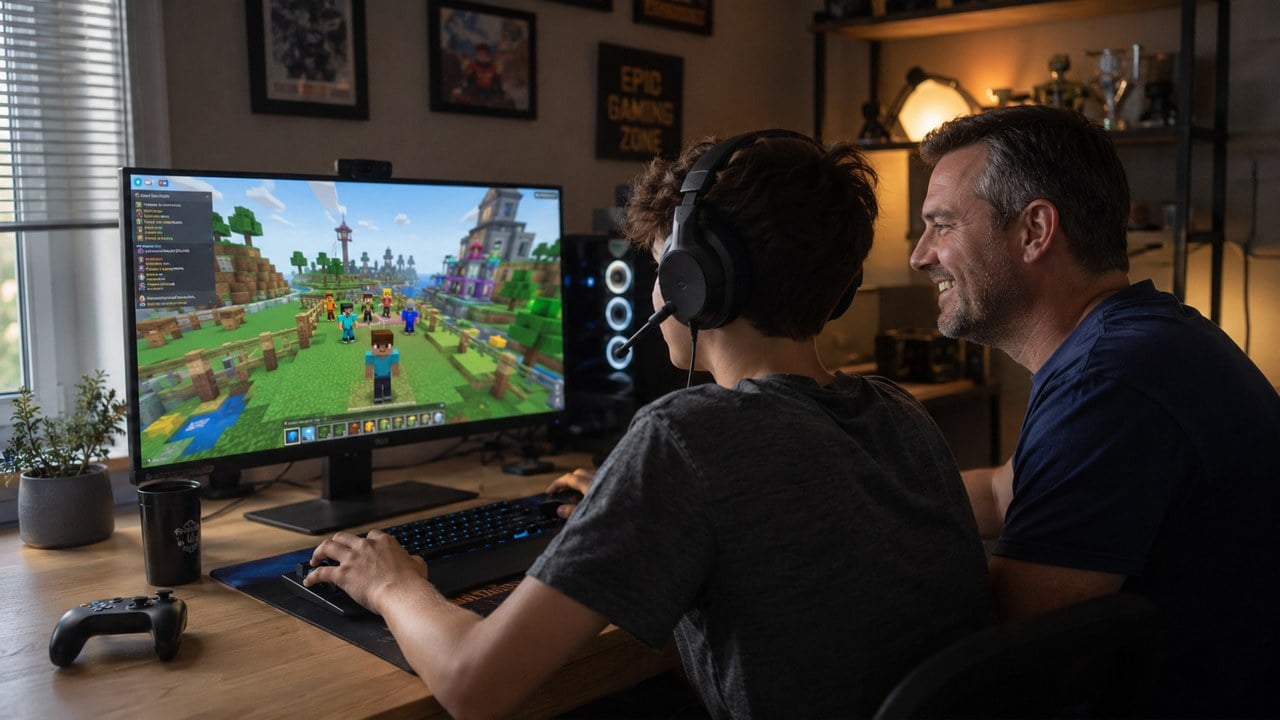
Participation beats supervision. Sit down and play. Ask who he plays with and how he knows them. Tabletop is a useful on-ramp, because everything happens where you can see it, and I have made the case before that playing games like D&D makes men better at life. Games deserve defending on their own terms, since the right games keep your mind sharp at any age. A dad who plays has standing to set rules. A dad who only confiscates does not.
Why a Scared Kid Is Less Safe Than an Informed One
The risk nobody plans for is the kid who is too frightened to speak. Scare a child hard enough and you do not get a cautious child, you get one who assumes he will be blamed and says nothing when a stranger starts getting friendly.
So make him one promise, out loud: he will never be in trouble for telling you something happened online, even if he broke one of your rules to get there. Even if he was on a game he was not supposed to be on, at an hour he was not supposed to be up. That carve-out matters more than any setting you change tonight, because every control can be worked around, and a kid who is afraid of you will not tell you when one is.
If something has already happened, keep the messages, report it inside the platform, and file with the National Center for Missing and Exploited Children at report.cybertip.org or 1-800-THE-LOST.