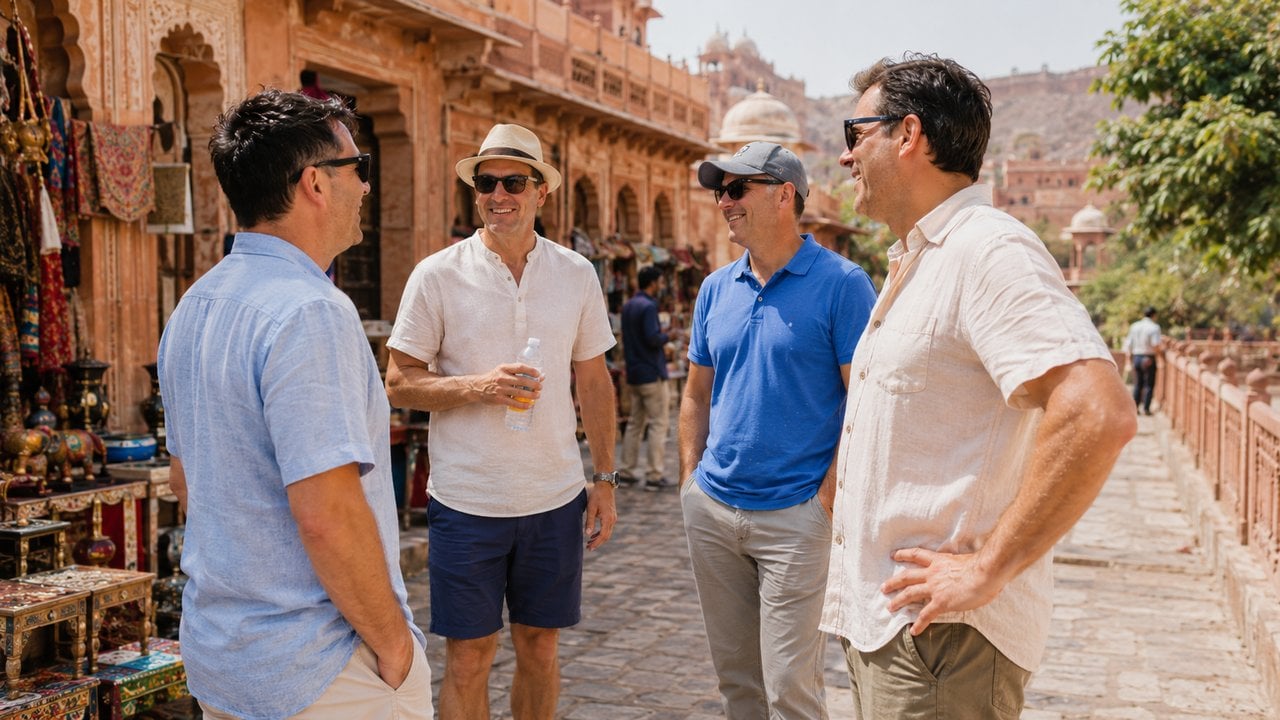
Rajasthan, Ranthambore, the Kerala backwaters, Goa and Ladakh are five regions of one country that share almost nothing with each other, and the flight times between them are longer than most people assume. A group trying to cover all five in two weeks will spend most of that time in airports. Pick two that share a season, book them properly, and India becomes one of the more rewarding guys trips on the board.
What Do You Call Your "Guys Trips"?
Each of these regions asks for something different from a group, and four of the five share a calendar.
- A haveli is the courtyard mansion of old Rajasthan, and the small ones now working as heritage hotels can be taken by a group outright.
- Ranthambore keeps a UNESCO-listed hill fort inside the reserve boundary, and the langurs have taken it over.
- Kerala's houseboats are converted rice barges called kettuvallam, chartered by the boat, not by the cabin.
- Goa divides into a loud north and a quiet south, and picking the wrong one costs you the week.
- Ladakh's passes are permit-only for foreign visitors, and it is not something you can sort out at the roadside.
Indian operators, heritage-hotel owners and houseboat charters generally take a small card deposit and settle the balance by bank transfer in rupees, cleared before anybody lands. Groups tend to leave that until last. Getting six men to fund it on time is easier when an India money transfer option is set up before anyone flies, instead of improvising from a hotel lobby in Delhi.

Promoted by FlowAds

Rajasthan, Where a Group Can Book an Entire Haveli
Three cities carry Rajasthan for a visiting party: Jaipur, Jodhpur and Udaipur, each within a day's drive of the next. October through March is the window, and by April the heat stops being a joke.
A haveli is the traditional courtyard mansion of northern India, built around an open central square so a household could sit outdoors without sitting in the street. Merchants and minor nobility put them up by the hundred across the state, and a good number now operate as heritage hotels. The smaller ones can be taken whole by six or eight men, which is a different trip from six rooms in a chain.
Move early on that. Rajasthan's peak season is also peak Indian wedding season, and small heritage properties get blocked out months ahead for wedding parties or priced accordingly.
Amber Fort, on a ridge outside Jaipur, takes a morning. Mehrangarh in Jodhpur is the better of the two, rising about 400 feet above the blue-painted old city with cannon still on the ramparts. Udaipur is the soft landing at the end, built around Lake Pichola with the City Palace running along one shore.
Most operators sell the state as an extension of the Golden Triangle, the Delhi to Agra to Jaipur loop that covers the Taj Mahal. Take the extension. The Triangle by itself is three cities of very heavy tourism, and Jodhpur and Udaipur are where Rajasthan stops performing for visitors.

Ranthambore Tiger Safari | Shared Canter, Jeep & Private Safari
Promoted by FlowAds

Ranthambore and the Gypsy Versus Canter Decision
The tigers are the draw. The location is why this reserve makes the list when Kanha and Bandhavgarh do not: Ranthambore National Park is near Sawai Madhopur in eastern Rajasthan, close enough to the fort circuit that a group simply drives in.
It was the hunting ground of the Maharajas of Jaipur before it was a reserve, and Ranthambore Fort still stands inside the park boundary as part of the UNESCO listing for the hill forts of Rajasthan. Langurs and deer hold the ruins now.
A canter is a twenty-seat open bus and a Gypsy is a six-seat Maruti jeep, and both cover the same zones at the same hours. Six men fill a Gypsy exactly, and it is worth the difference in price for the quiet alone.
Zones are assigned, not chosen, and permits come through the forest department's online booking system. The core zones close through the monsoon and reopen in October, which puts the reserve on the same calendar as the rest of Rajasthan. Nobody guarantees a tiger, and two drives give far better odds than one.

Promoted by FlowAds

Chartering a Kettuvallam on the Kerala Backwaters
Kerala's backwaters are a linked network of lagoons, lakes and canals running parallel to the sea behind a thin strip of land. Alleppey is the usual base, Kochi is the usual airport, and the season matches Rajasthan's: roughly October through March, with the monsoon owning the summer. Sri Lanka is a short hop off the same stretch of water on much the same calendar, which is why a party weighing the backwaters sometimes ends up planning a Sri Lanka mancation instead.
Locals call the boats kettuvallam, roughly translatable as tied boat, because the originals were rice barges built from planks lashed together with coir rope instead of nails. They hauled grain long before tourism found them. The converted ones carry two to six bedrooms, a cook, and a pilot who knows the channels.
Skip the day trip and take the overnight. The day version motors out, feeds you lunch and turns around. The overnight moors on Vembanad Lake, the largest of the backwater stretches, and the evening on deck is the part people describe when they get home. Because a party takes the whole boat, this is closer to renting a floating villa than buying a cabin on a ship.
Sort the drinks with the operator when you reserve. Kerala has its own liquor licensing and it catches visitors out, so ask the charter what can come aboard instead of assuming.

Promoted by FlowAds

Goa Splits North and South, and It Matters Which
Which end of Goa you sleep in sets the character of the whole week. North Goa around Anjuna, Baga and Calangute is the loud half, with the beach shacks, the flea markets and the nightlife that landed Anjuna on our list of the best beach parties for a bachelor party. South Goa around Palolem and Agonda is the quiet half. A party that wants a beach instead of a scene should stay south and drive north on the one night it wants the noise. November through February is the stretch of good weather.
The state was Portuguese until 1961 and still reads that way in the churches, the surnames and the food. Old Goa is worth a half day inland, where the Basilica of Bom Jesus holds the remains of St Francis Xavier inside a cluster of Portuguese churches that UNESCO lists together.
Further inland, Dudhsagar Falls drops in tiers down the Mandovi River at the Karnataka border, inside the Mollem forest. The name translates as sea of milk, and the falls make the case for it on sight. You reach them by jeep, because the last stretch is no place for a car, and they pair naturally with the spice plantations in the same district.
If anybody plans to rent a scooter, bring an International Driving Permit, specifically the 1949 version, alongside your home license. Police checkpoints are common, riding without one is the standard way visitors collect a fine, and the permit has to be issued in your home country before you travel. The traffic is the better reason to take it seriously, though. Goan roads mix scooters, buses, livestock and unlit potholes, and a rented two-wheeler is a common way for a visitor to end his trip early.
Goa distills its own spirit, feni, from cashew apple or coconut sap, and it is not sold outside the state, which makes it worth a glass while you are here. It is also stronger than it tastes, and the roads are not the place to find that out.

Promoted by FlowAds

The Manali to Leh Highway on a Royal Enfield
Groups come to Ladakh for the road itself. Where it ends up is almost beside the point. The region is the far north of the country, between the Himalaya and the Karakoram, and the classic run is Manali up to Leh, roughly 300 miles of switchbacks and high passes on Royal Enfields. It is a seasonal road: snow closes it, it generally opens somewhere around late May or June, and it shuts again in September or October.
This is a demanding ride and not a beginner's one. Loose surfaces, unlit tunnels, water crossings and long days at altitude are a different proposition from a highway run at home, and it is worth knowing what a long day in the saddle costs you before signing the group up for two weeks of them.
Foreign nationals also need a Protected Area Permit for the border zones, Pangong Tso and the Khardung La corridor among them. It has to come through a registered agent, not over a counter, and it is issued to a minimum of two foreigners traveling together, so a solo rider needs to find a second before the permit will issue at all. Build it into the itinerary early, because a checkpoint is a poor place to find out.
Khardung La is the pass that ends up in everybody's photographs. The sign at the top claims 18,380 feet while surveys put it closer to 17,582, which is still high enough to leave a fit man breathing hard on the walk to the tea stall. Pangong Tso, the lake on the Chinese border at around 14,000 feet, is the other standard ride out of Leh, though foreign visitors are held to the north shore around Spangmik, not the length of the lake.
Plan around the altitude before the road. Leh is at roughly 11,500 feet and most flights land there directly from Delhi, which takes a body from sea level to eleven thousand feet in under two hours. Give everybody two days doing nothing before a single bike gets started.
Skip that and the usual price is a wasted day in a hotel room. The rarer version is worth naming plainly: altitude sickness can progress to fluid on the lungs or the brain, and it can kill. If a man's symptoms are getting worse instead of settling, he needs a doctor and a lower elevation, not a tough afternoon.
Visas, Trains, and When to Just Fly
Americans need a visa, and the electronic one covers a trip of this length. Apply on the government's own India e-Visa portal and ignore the lookalike sites that outrank it in search, which charge upwards of a hundred dollars to file a form that costs a fraction of that direct and cannot make approval come any faster. Mind the entry rules as well: the e-Visa admits you at designated airports and seaports only, with a pair of Nepal land crossings the sole exception, so anyone routing in overland needs the paper visa. Passports need at least six months of validity past the arrival date.
Talk to a travel clinic in the same month you book. Typhoid and hepatitis A are the usual recommendations for India and some of it needs lead time, and a doctor who knows your itinerary will tell you what the regions you picked call for. Then be disciplined on the ground: sealed or boiled water, no ice from an unknown source, and hot food from a busy vendor over lukewarm food from an empty one. A bad two days is the most common thing that costs a group part of its week.
Trains are the good version of Indian travel, and the IRCTC portal is where they get reserved. Air-conditioned sleeper classes sell out early, particularly on the overnight routes, so lock those in once the dates are fixed.
For the long hops, fly. Delhi to Goa, Delhi to Leh and anything to Kochi are flights, not train journeys, unless the guys have decided the train itself is the point.
How Indian Operators Want to Be Paid
Cards work at hotels, airline counters and city restaurants. Everything else runs on cash: the markets, the auto-rickshaws, the tea stalls, the small guesthouses, and the tips that keep a driver cheerful across two weeks.
India's own payment rail is UPI, and it is close to universal domestically, but it is built on Indian bank accounts and Indian phone numbers, so visitors sit outside it. Indian ATMs also hand out less per transaction than most Americans are used to, which turns a cash-heavy fortnight into a series of small withdrawals instead of one big one.
One man fronting a haveli buyout on a personal card and then chasing five work colleagues for their share afterwards is how a trip like this picks up a grudge it never loses. Settle the big items before departure so nobody is carrying the group's balance on his own account.
Do that setup on a connection you control, and install it before you leave home. Between the transfers, the IRCTC account and a fortnight of hotel and airport wifi, this is a trip that hands your banking to a lot of networks you have never met, which is what a travel VPN is for.
More India Experiences for Your Guys Trip


Promoted by FlowAds

Ladakh Does Not Combine With Anything Else
Four of these five share a calendar. Rajasthan, Ranthambore, Goa and Kerala all have their best weather somewhere inside October to March, with Goa's window the tightest of the four, which is why any two of them pair without a fight and why the winter version of this trip has six workable combinations in it.
Ladakh is the exception. Flights reach Leh for most of the year, but the passes that make the ride worth doing open only from about late May until September or October, and that is the same stretch when Rajasthan turns punishing, the coast sits under monsoon, and Ranthambore's core zones are shut. That makes Ladakh a standalone trip rather than a leg of a bigger one.
Pick the season first and the regions second. If it comes out as the winter version, start with Ranthambore. The good safari zones disappear within a day of release, and the haveli, the houseboat and the internal flights will all move around a fixed tiger permit.